AKQA
Creative Operations, PMO & AI Transformation
Overview
What I Did
As Group Program Director at AKQA, I ran a $30MM+ portfolio of enterprise clients and built the operating model, workflows and PMO behind their work. Then I rebuilt much of it with AI, from intake and resourcing to synthetic testing, localization and real-time social listening.
Note: Due to NDA and disclosure, some of the framework images are AI representations to simplify workflow visualization
My Role
Senior Director, Creative Ops & Program Management
Core Disciplines
My Remit
Portfolio: led delivery for 4–6 enterprise clients at a time, totaling more than $30MM.
People: managed 15 managers and was the escalation point for multi-discipline teams of up to 70.
Operating model and PMO: owned how work was scoped, staffed, governed, delivered and reported across the portfolio.
Ways of working: defined the standard workflows for web design and build, campaigns, and resource and capacity management.
Commercials: negotiated client payment terms and vendor deals, and built them into the workflow.
AI transformation: turned the operating model into an AI-enabled one, building the tools myself and leading their adoption.
A flexible operating model
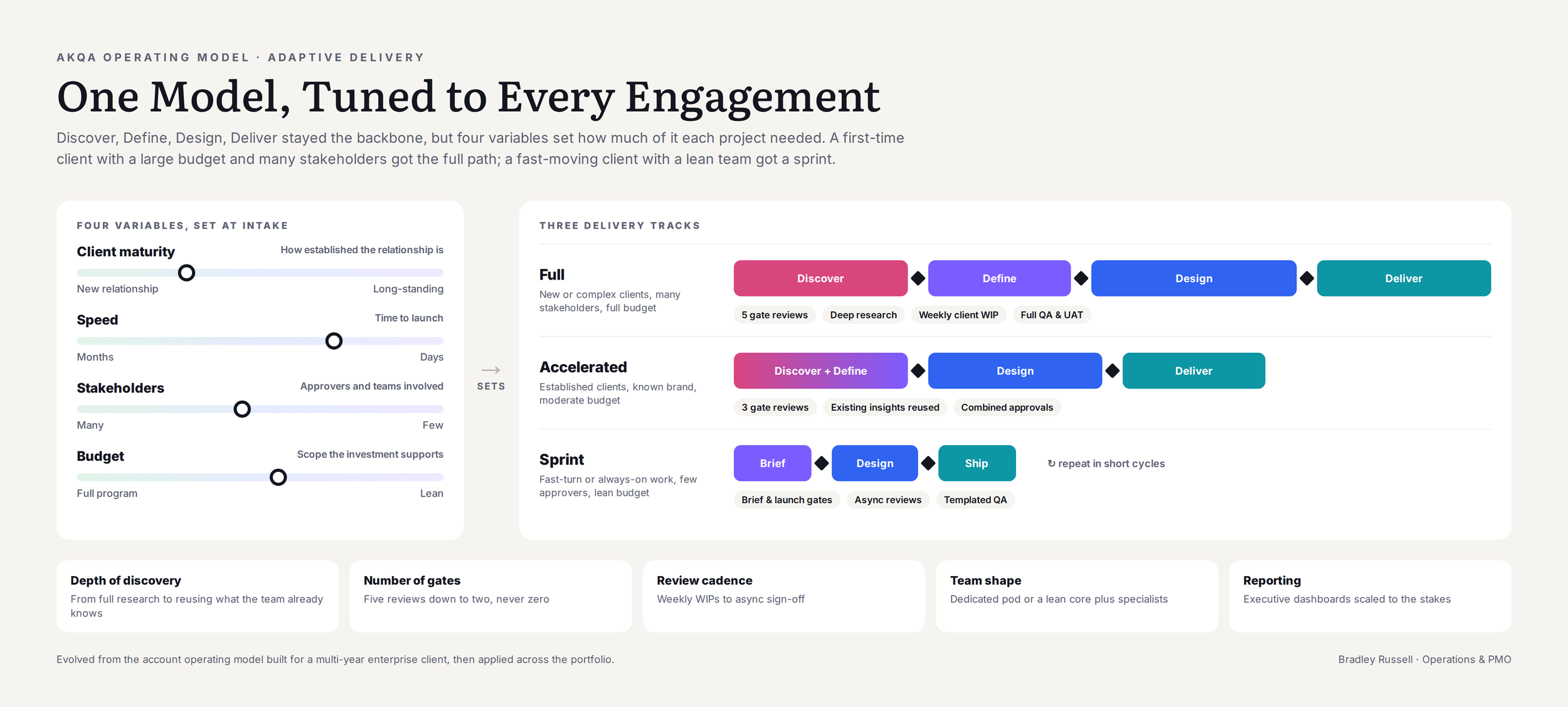
Full: every phase and gate.
Accelerated: discovery and definition combined, with fewer reviews.
Sprint: brief, design and ship in short cycles.
The backbone and the quality bar stay the same. What flexes is the depth of discovery, the number of gate reviews, the review cadence, the team shape and the level of reporting.
Intake & Scoping
The operating model started on the IBM account, built on a Discover, Define, Design, Deliver process with stage gates. As I applied it across the portfolio, I learned that no two engagements use the exact the same amount of process; a new client with many stakeholders needs depth and rigor, a startup moving fast with a lean budget needs speed.
So I evolved the model to be variable-based. Four inputs set at intake (client maturity, speed, number of stakeholders and budget) dictating which delivery track a project follows:
Standardized ways of working
Web / Digital
-
Web design and build. One end-to-end process for every web launch:
concept to design;
design-to-development handoff with annotated specs and a shared component library;
AI coding tools sped up development, and a custom tool tracked content authoring.
Accessibility, AI-assisted checks flag issues for human review and fixes.
UAT stayed deliberately human: BAs ran a simple test-data setup script, then tested manually against defined cases and checkpoints.
Campaign
-
Campaigns move fast, and vendors need payment before the work begins. I renegotiated client contract, payment and invoicing terms so funding arrived before a campaign concept was final, letting us commit to production partners without delay. I revise our ways of working for commercial and business affairs to accommodate real world scenarios
Resourcing & Capacity
-
I rebuilt how we planned people across the portfolio: forecasting demand against capacity, flagging overbooking early, and connecting staffing to budgets and revenue.
Governance Control
-
Fast-moving clients change their minds daily, and scope can disappear quietly into a dozen Slack threads. On Replit, three to four change requests a day were arriving through Slack, email and meetings. I built a governance portal that captured every request in one place, sorted it by scope impact and drafted the estimate. I approved each change order at three gates before it went out for e-signature. Over six months it saved me 600 hours and my team more than 1200, it has since scaled.
AI Transformation
Briefs were structured automatically on intake, and first-draft scopes and estimates were generated from them. Teams started from a solid draft instead of a blank page.
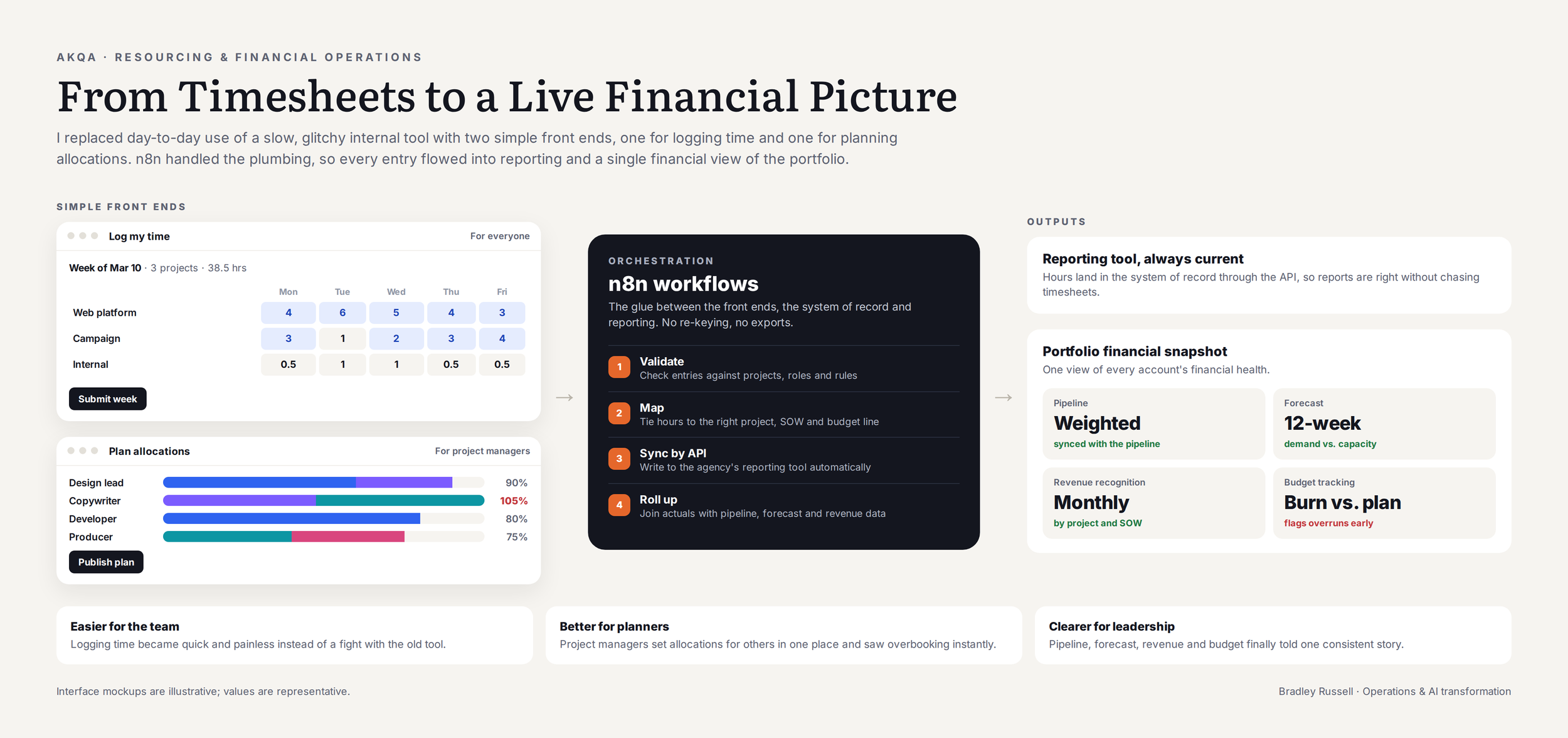
With the operating model in place, I started transforming it with AI. I mapped every step of our campaign and web processes for where AI could augment the team and where it could automate the task.
The rule was simple: high-empathy work such as strategy, ideas and judgment remained human-led, while high-volume, repeatable work gets automated.
I built the highest-value pieces first.
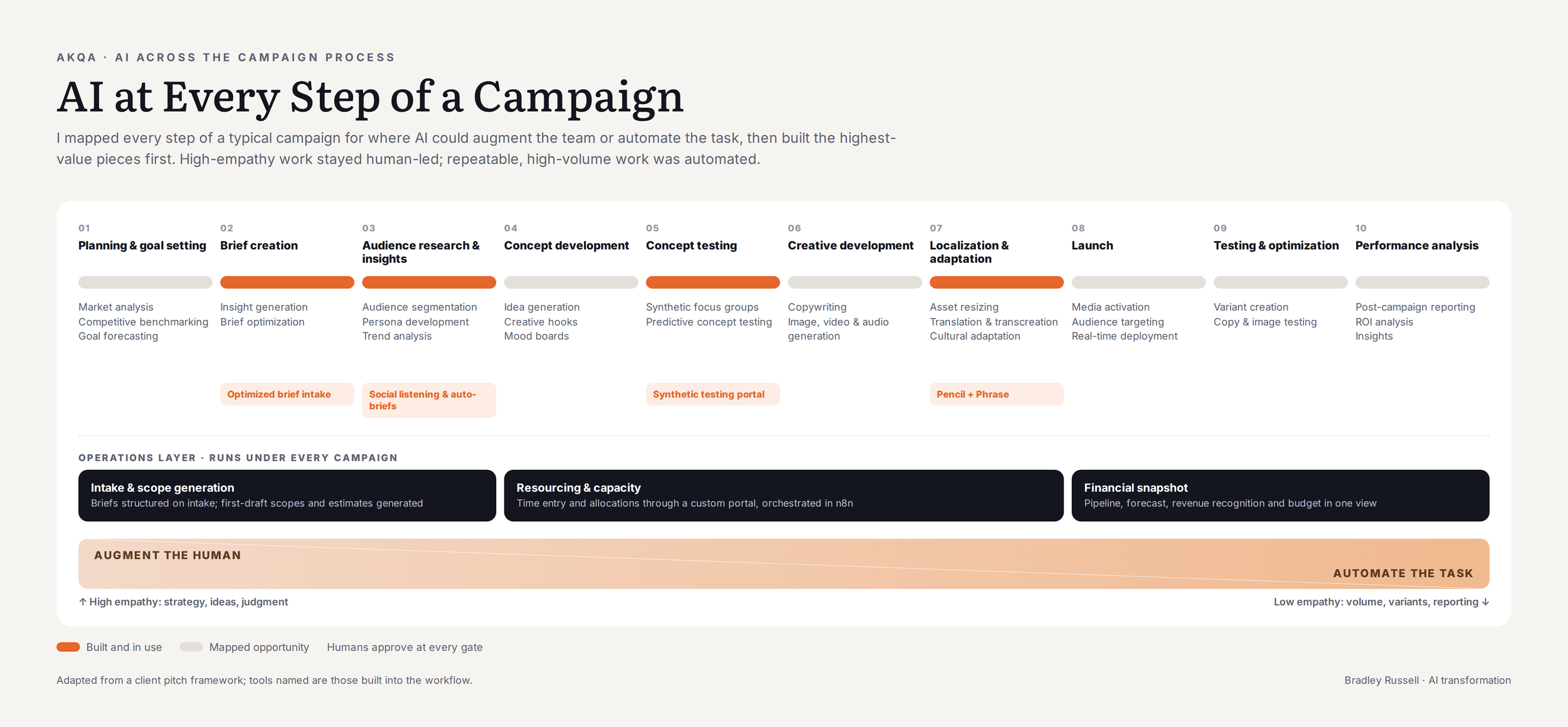
Our internal resourcing tool was slow and unreliable, so I built two simple front ends on top of it:
a portal where everyone logs their time;
a planner where project managers set allocations for their teams.
n8n handled orchestration, validating entries, mapping hours to the right projects and budgets, and syncing everything to the agency's reporting tool through its API. The same data rolled up with pipeline, forecasting, revenue recognition and budget tracking into one financial snapshot of the portfolio.
Synthetic Testing
I built a synthetic testing portal that works like an on-demand focus group:
Resourcing & Reporting
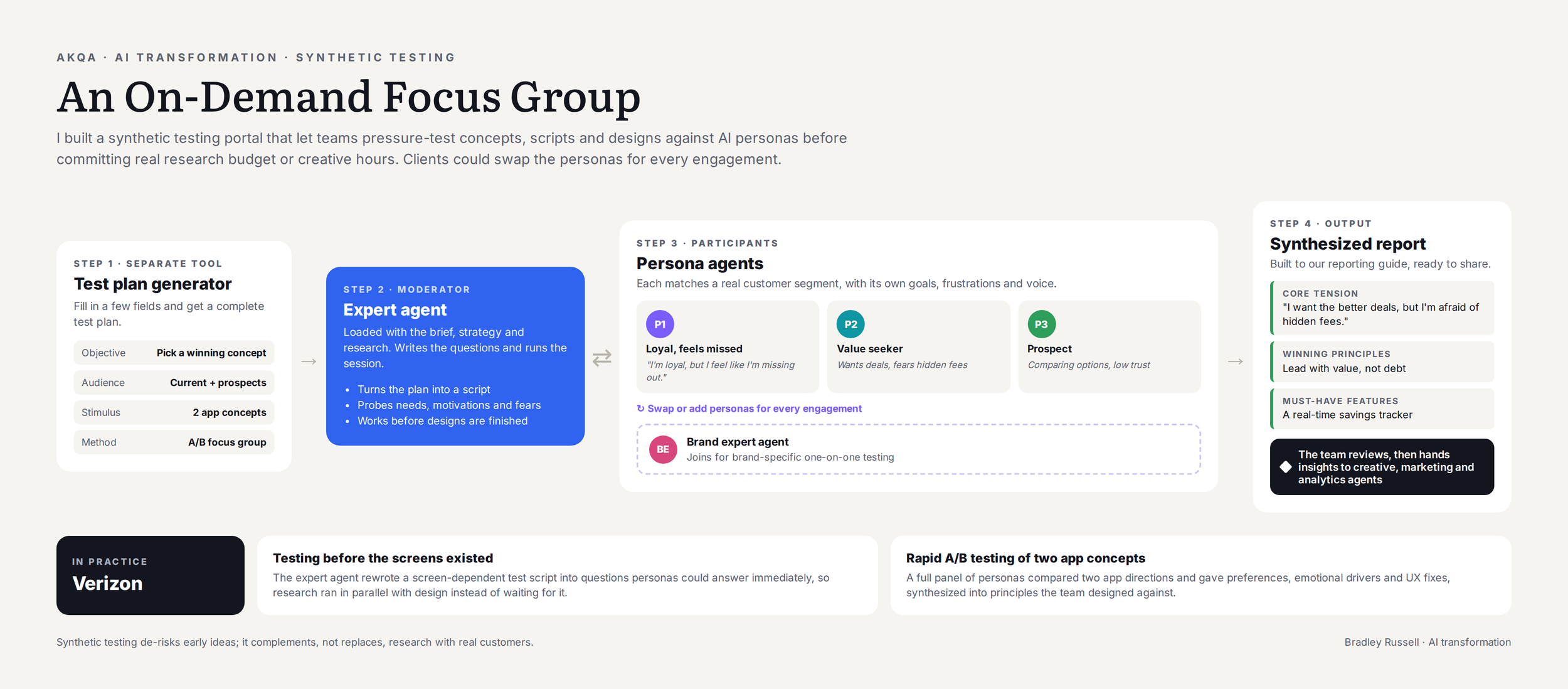
An expert agent loaded with the project context writes the questions and moderates the session.
Persona agents, each matched to a real customer segment, respond in their own voice. Clients can swap them for every engagement.
A brand expert agent joins when a test needs brand-specific, one-on-one feedback.
Synthesized reports follow our guide.
I integrated Pencil into the production workflow to automate resizing and versioning across formats.
Localization & Transcreation
Many releases we’re global. I set up Phrase, an AI localization platform, and built it into our workflow. Translation alone wasn't enough; we needed transcreation that carried the sentiment, not just the words. AI gave the team a strong first draft to take into language testing, and native-speaking reviewers stayed the final approval at every gate.

Asset Resizing
Social Listening
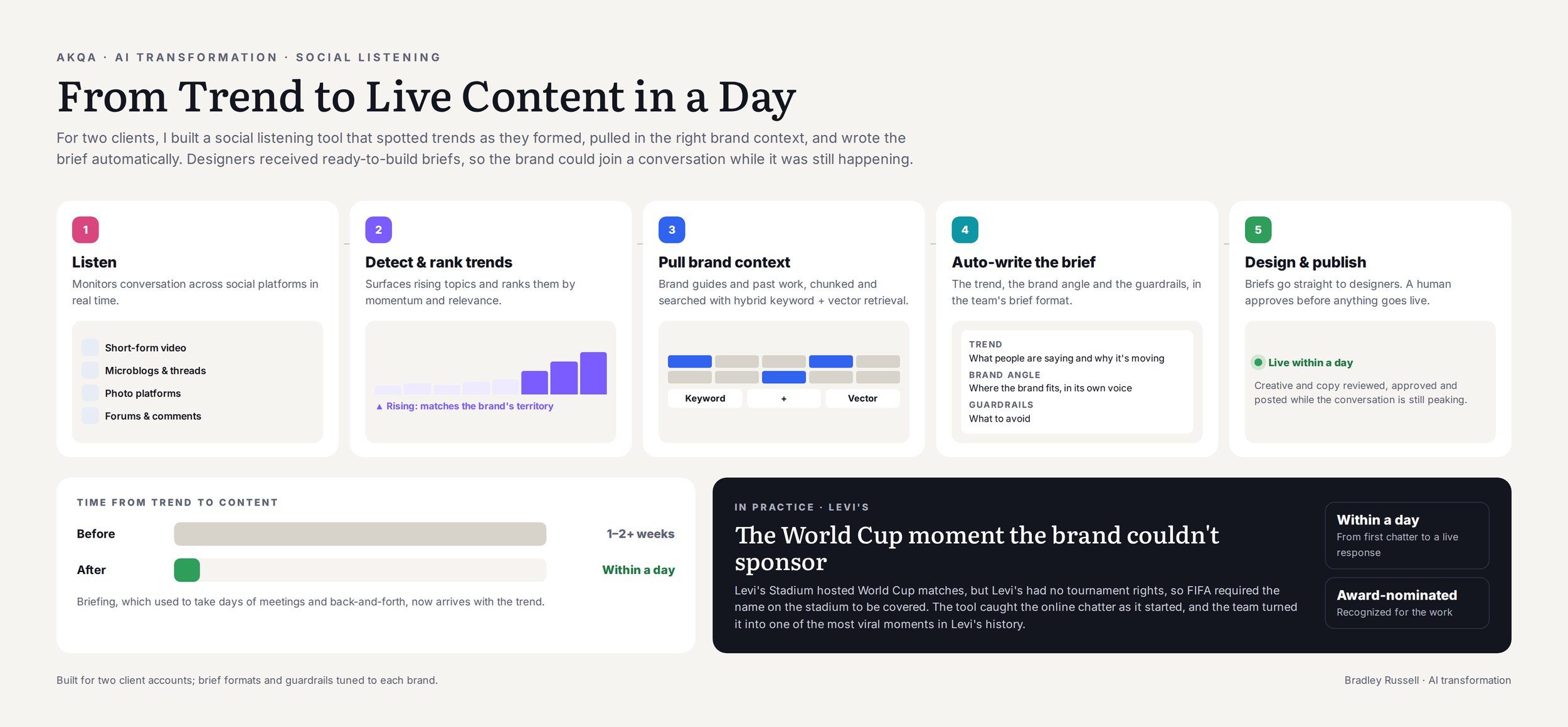
For two clients, I built a social listening tool that tracked trends across social platforms in real time and surfaced the ones that mattered.
It wrote briefs automatically, pulling in brand context through chunking and hybrid keyword-and-vector retrieval.
The briefs went straight to designers, so the brand could respond to a trend within a day instead of the one to two weeks it used to take.
The highlight was Levi's at the World Cup. Levi's Stadium hosted matches, but Levi's had no tournament rights.
The team caught the online chatter and turned it into one of the most viral moments in Levi's history. The work is now nominated for industry awards.
Related work powered by the process