Replit
Righting the Ship on a Four-Month Launch
Overview
What I Did
Replit hired AKQA to rebrand the company, rebuild its website, launch two campaigns, and launch their new product on a fixed date: Agent 4. I was brought in midstream to rescue an engagement that was failing. I rebuilt the operating model and commercial approach, and built the AI automation and governance tools that got six parallel workstreams across the line.
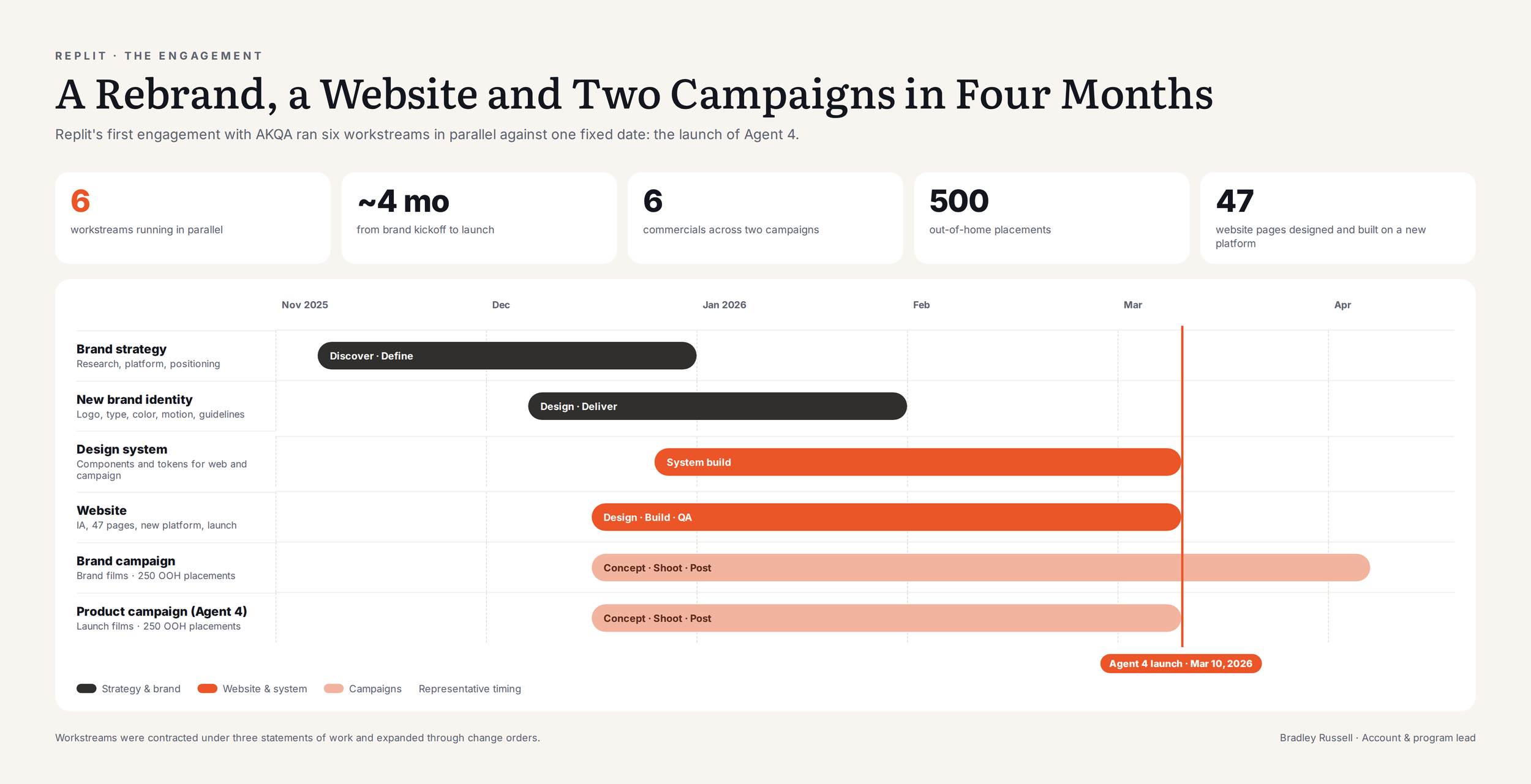
All six workstreams ran in parallel. The brand work kicked off in November 2025, and everything had to be live for the Agent 4 launch on March 10, 2026.
I was brought in to help right a slowly sinking ship, the operating model I was rolling out across the portfolio had not been implemented; Replit was setup as a parallel workstream project with key dependencies but it was being run as traditional waterfall.
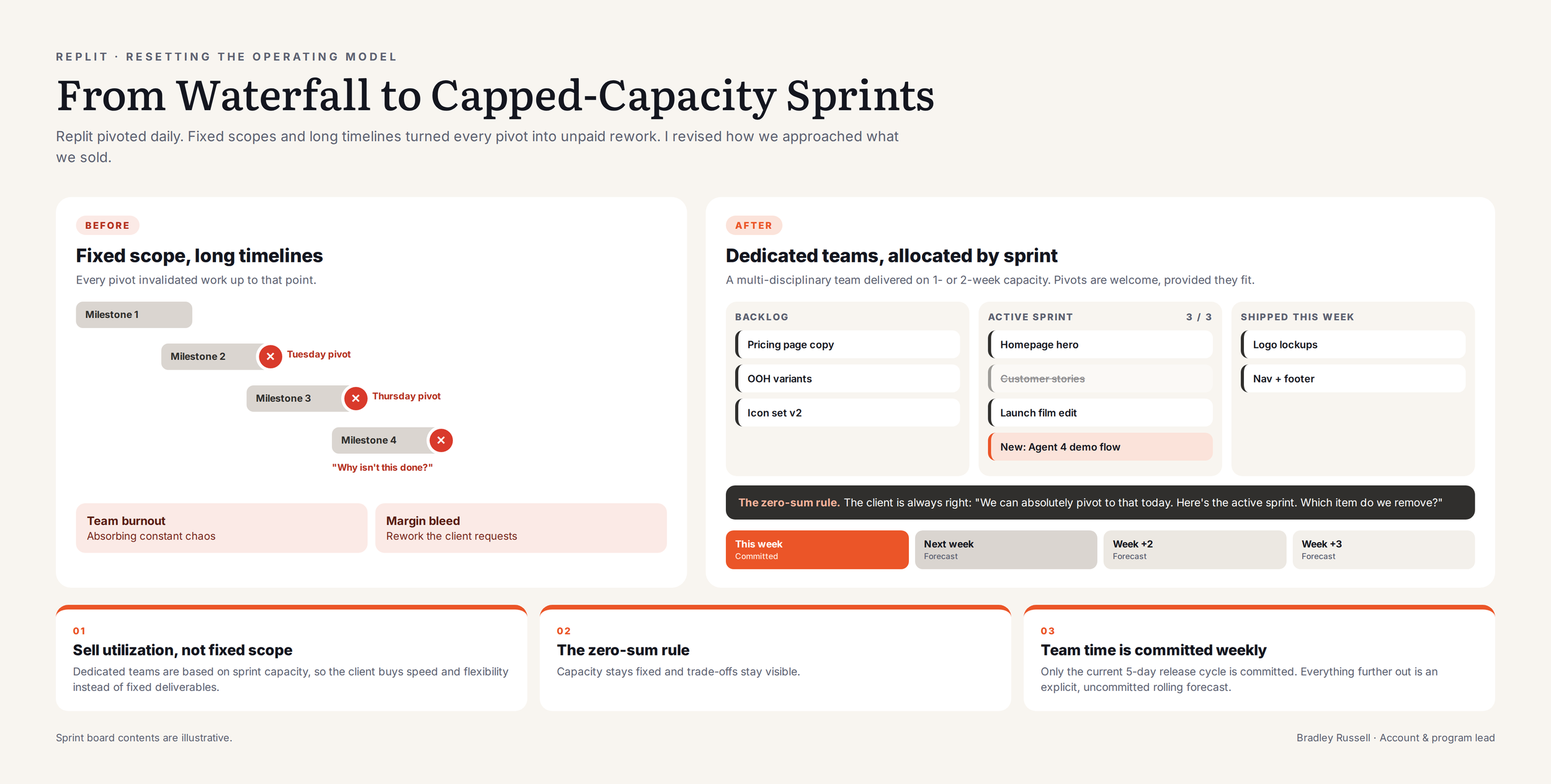
With a client this fast and this loosely accountable, waterfall guaranteed two things: the team burns out absorbing the chaos, and the agency loses margin to rework the client requests they asked for.
The Reversal
1.)
My Role
Senior Director, Creative Ops & Program Management
Core Disciplines
My Engagement
Replit was AKQA's first AI startup client, and the scope reflected that:
Brand strategy: research, positioning and a new brand platform
New brand identity: logo, type, color, motion, photography guidelines
Design system: the components and rules behind every new touchpoint across all channels
Website: a new information architecture and 47 pages designed and built on a new platform, including the Agent 4 launch page
Brand campaign: 2 commercials and 250 out-of-home placements
Product campaign (Agent 4): 4 commercials and 250 out-of-home placements
Replit moved at a speed we weren't prepared for. Everyone wore several hats and decisions were made collectively, which in practice meant nobody owned them. Issues piled up, requirements shifted daily, and decisions were made, forgotten and remade.
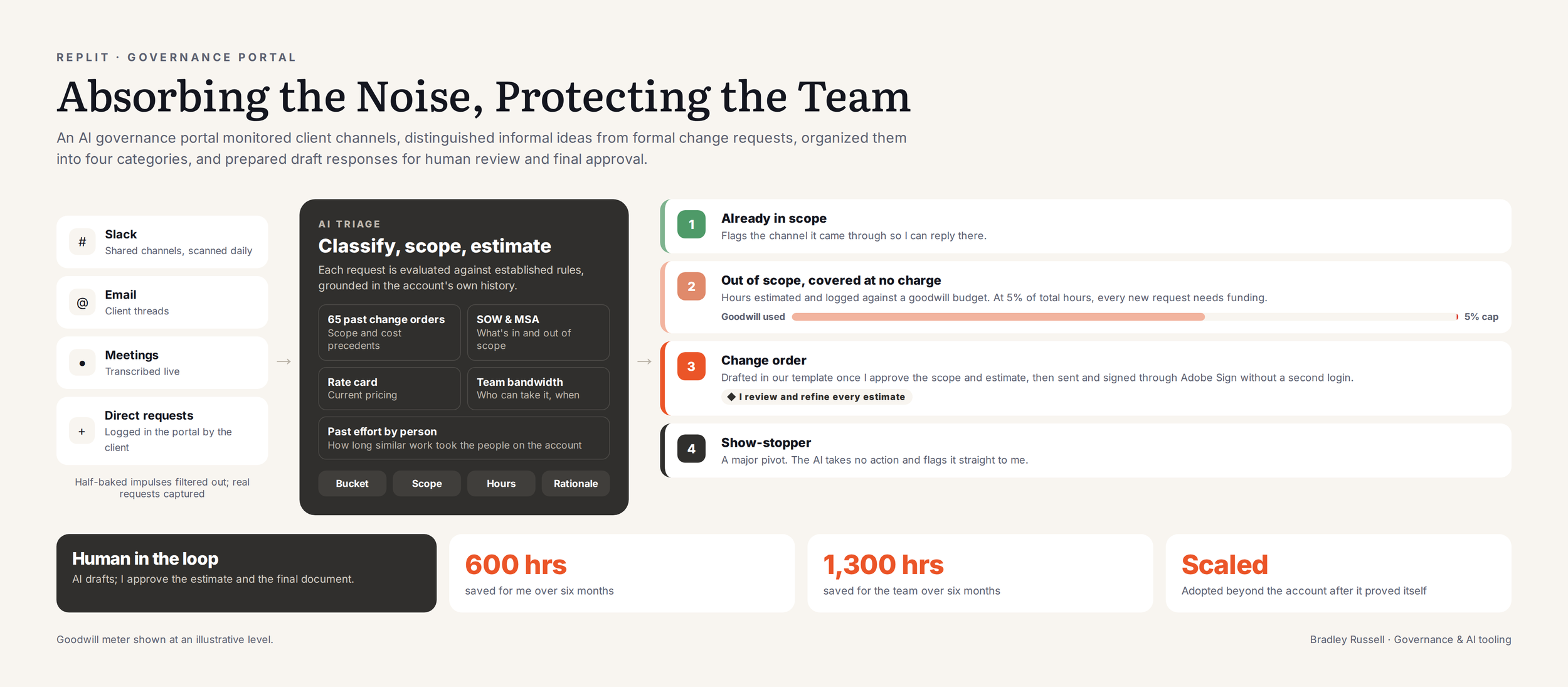
I built an AI governance portal that listened to every channel the client used: Slack, email and live-transcribed meetings, plus requests logged directly through the portal. It filtered out half-formed ideas and caught every real change request. It sorted each request into four buckets:
Implement a new commercial and operating model.
Waterfall failed because every pivot invalidated previous work without a change order. So I changed our commercial model.
2.)
Build a governance portal to protect the team
The Challenge
Already in Scope
The tool provided the channel the request was received and I responded accordingly.
Additional optimizations were brought in to help stabilize workflows and improve efficiency given time pressures.
A project repository agent. Powered by Claude, it covered every piece of data, work, concept, input and document the client shared, we created, and chunked and searched with hybrid keyword and vector retrieval. The client and our team could ask it anything, and answers came only from that closed set of project material. It was invaluable when the team explored say, 400+ logo concepts.
Pencil, for automated asset resizing across the campaign's formats.
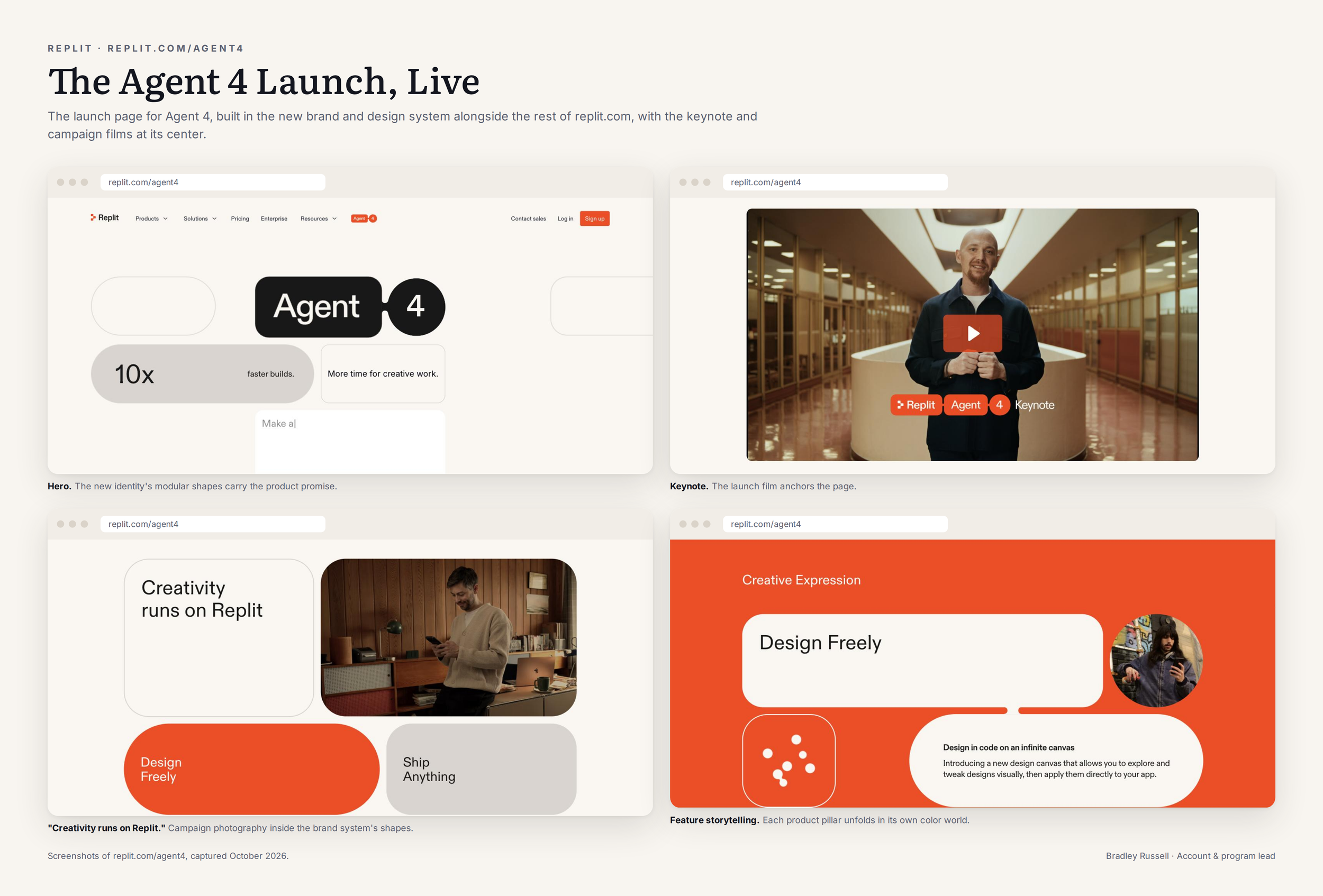
The new brand, design system, website and both campaigns launched on time:
7 commercials
500 out-of-home placements
New website, including the Agent 4 launch page.
The governance portal gave back more than 1,900 hours across the team
Operating model and tools were scaled beyond the account.
Out of scope, but we'll cover it.
This was the hardest bucket to define, because it's contextual by nature. The AI worked from established rules, grounded in 65 past change orders, our SOW and MSA, and my own notes.
For each request it proposed a position and rationale, then estimated hours and scope using the change-order history, the current rate card, team bandwidth and how long similar work had taken the people on the account.
The tool also kept a running total of the free work we were absorbing. Once that hit 5% of total budgeted hours, every new request, no matter what, required incremental funding.
Change order
Requests followed similar process. I reviewed and refined the scope and estimate, and once approved, the tool drafted the change order in our template. It synced with Adobe Sign, so reviews and signatures happened without a second login.
This tool saved me ~600 hours
This tool saved my team ~1300 hours
The Result
Show stopper
A major pivot that needed real discussion. The AI took no action and flagged it straight to me.
3.)
Driving accountability
Fast-moving AI teams often suffer from selective amnesia: they pivot from an approach one day, then ask a few days later why it wasn't finished.
A timestamped decision tracker: recording who decided what, and when.
A 10-minute async daily recap, drafted by an AI agent I built. At the end of every business day, the agent posted the same data to client leadership: what was completed that day; what was pivoted or paused, who authorized it; what is planned for tomorrow; and which decisions are blocked waiting on client input.
Stage gates with confidence levels. The original setup had skipped my stage-gate process, so I reinstated it, sized for the pace. Each gate stated how settled the work was, from directional to committed to locked, so nobody mistook a draft for a decision.
4.)
Bringing proven tools to a new account